
– Biomechanics –
Both arms, the engagement of the hip, and (if applicable) the extension of a leg work together to make the arm techniques powerful and swift. This chapter elaborates on the principles that underpin this collaboration.


Compliant technique
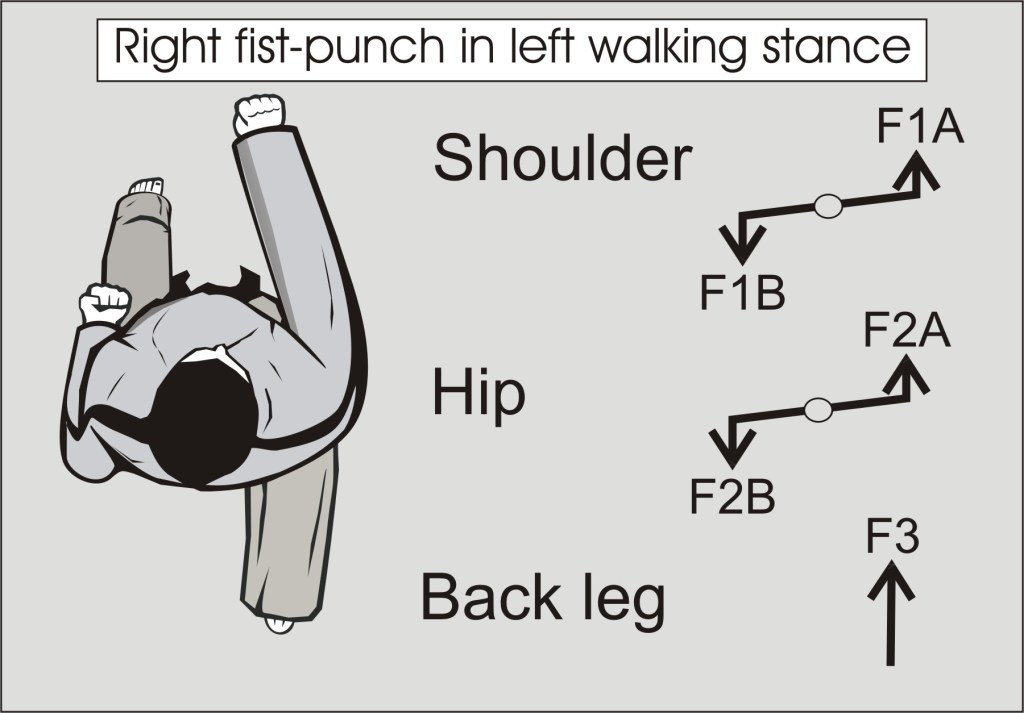
The most powerful technique occurs when, for example in a walking stance, the back leg, together with the rotation of the hip and the rotation of the shoulders/arms, all move in the same direction. The coupling forces F1A + F1B from the shoulders, along with those from the hip F2A and F2B, and the force from the extension of the back leg F3, together form the strength of the technique.

Opposite technique

In this case, the right fist punch is supported by the rotation of the shoulder belt and the hip drive, but not by the extension of the back leg. For the power of the technique, the rotational forces of F1A and F1B and the hips F2A and F2B are summed. The extension of the left leg is performed in a relaxed manner and adds nothing to the technique’s power.

Double technique
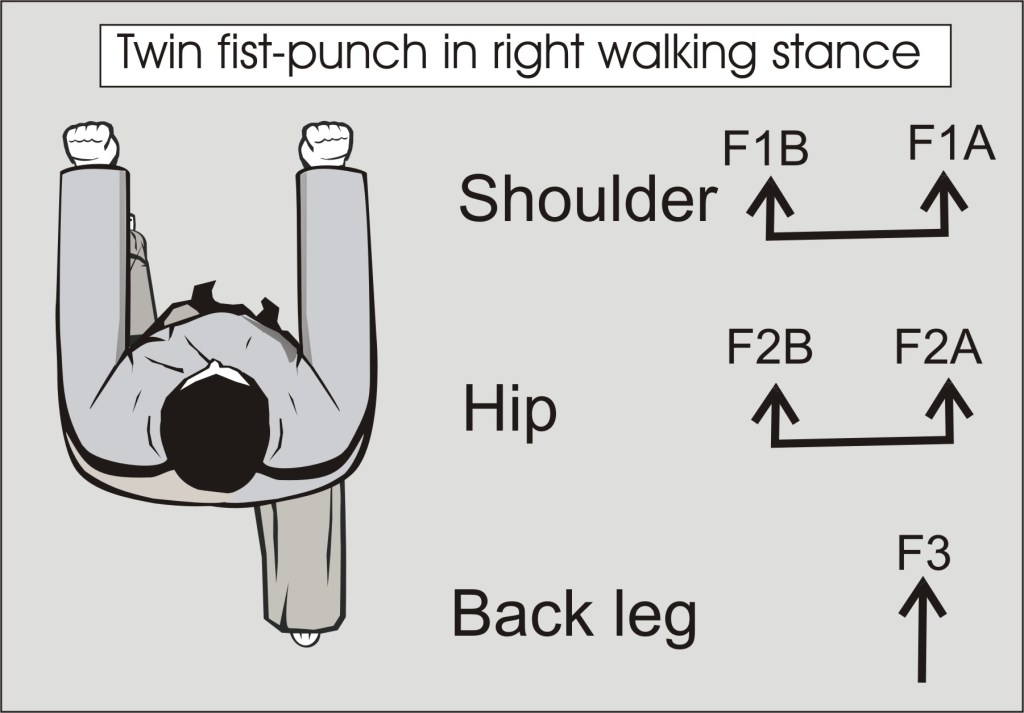
In techniques performed with two arms, the shoulders and hips do not rotate but tilt. For example, in this twin fist-punch, the hip tilts from back to front while extending the arms. The left arm results from F1B, F2B, and half of F3. The right arm = F1A + F2A and 1/2F3.


 tulsonline.com