
– Biomechanics arms –
The strength that arm techniques can develop largely comes from the collaboration based on biomechanics between technique and counter-movement. This page elaborates on this.


Both arms work together in many different ways, either as support or additional control. When both arms perform a technique, that is not the case. The support takes three different forms:
Supportive
For example, with a fist-punch:
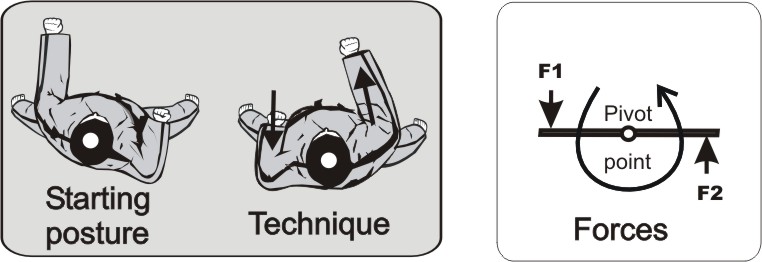
With a fist-punch, force is generated because the counter-movement (F1) and the technique arm (F2) (along with the entire upper body) rotate around the vertical midline. The technique then moves with great force towards the target (and hits), while the counter-movement does the same in the opposite direction (but without hitting anything).
In this way, the counter-movement adds force to the technique.

Neutral
The counter-movement can have an opposite rotation to the technique. In that case, this does not generate any force.
For example, a right forearm-block:
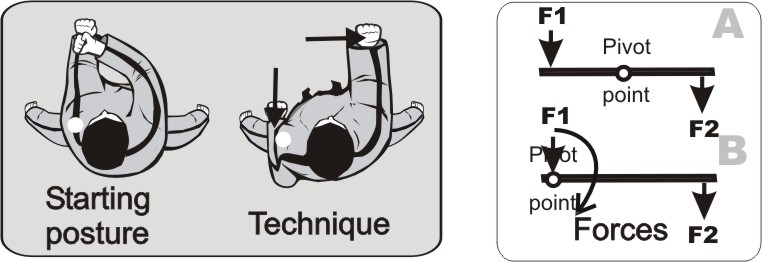
This technique starts in a crossed starting posture on the left flank line. If the pivot point were to lie in the middle (A), the technique arm (F2) would turn clockwise and the counter-movement (F1) counterclockwise. The counter-movement does not support the technique now and even works against it. That can never be the intention of a counter-movement.
The body knows how to handle this, as in order to generate strength, the pivot point shifts from the center to the shoulder in the counter-movement (B). Now the shoulder and the right arm rotate clockwise. The left arm goes straight back, without causing a rotation of the body.
Now the counter-movement no longer works against it and remains neutral.

Combined
The counter-movement can work both supportively and oppositely, in a guarding forearm-block for example:
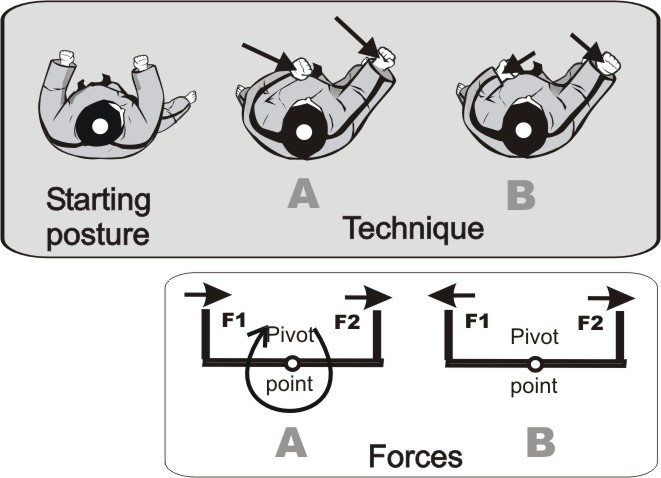
After the parallel starting posture beside the body, both arms cause a clockwise rotation. Just before the contact point, the counter-movement (F1) goes counter-clockwise so that the hand can end up directly in front of the sternum. Initially, the counter-movement supports the technique (F2), but in the end, it works against it.
This generates extra force for the technique while also withdrawing the energy of the technique at the end through the counter-movement.

 tulsonline.com