
A guarding block is an impressive technique due to the posture and biomechanics behind it: first both arms rotate in the same direction, but at the end the reverse arm pulls back to the centre of the body. It gives power and a pefect stop.
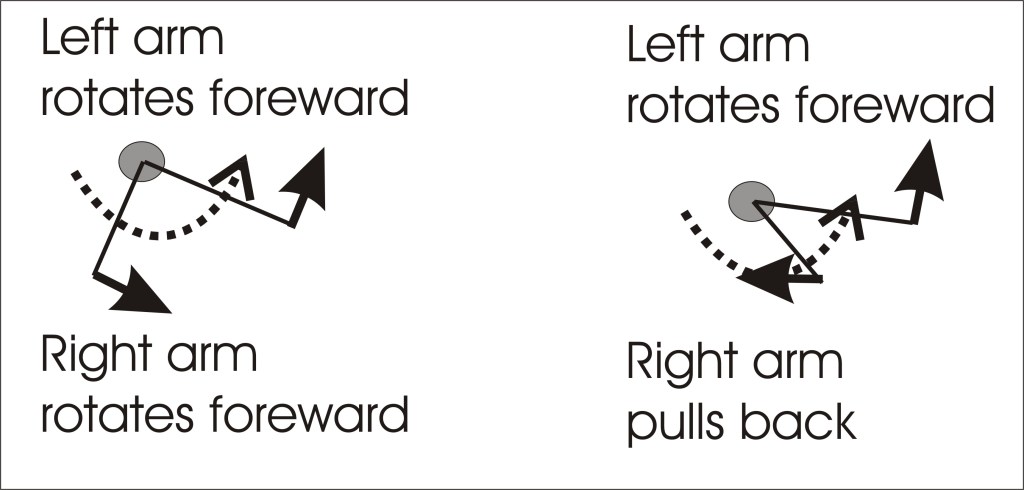


In a defensive block, one hand performs the technique while the counter-movement goes towards the middle of the chest. In the Tuls, This block has two executions, with knife hands and with fists. The front hand can serve as a block at low, middle, or high level, with contact on the inside or outside of the hand. The rear hand provides the counter-movement. Both hands are either open or closed.
A guarding block is applied as a defense or as a warning. If in the Tuls a guarding block is followed by an attacking technique (Dan-Gun Tul), it is considered a defense. If the guarding block is the last position in a Tul (Won-Hyo Tul), it serves as a warning and the speed of the technique is slowed down. A guarding forearm block is also part of the sideward bending posture (Won-Hyo Tul); this is also intended as a warning.
A defensive block is executed in the L or back stance. This stance is positioned slightly diagonally from the front, which gives the leading arm a bit more length.
The first thing that stands out about this technique is that it is composed of two triangles. The feet form a triangle, and the arms also create a triangle. The triangle is the most stable geometric shape, and that contributes to the unique appearance of this technique.
The power inherent in this technique comes from the unique biomechanics that underlie it. It proceeds in phases as follows:
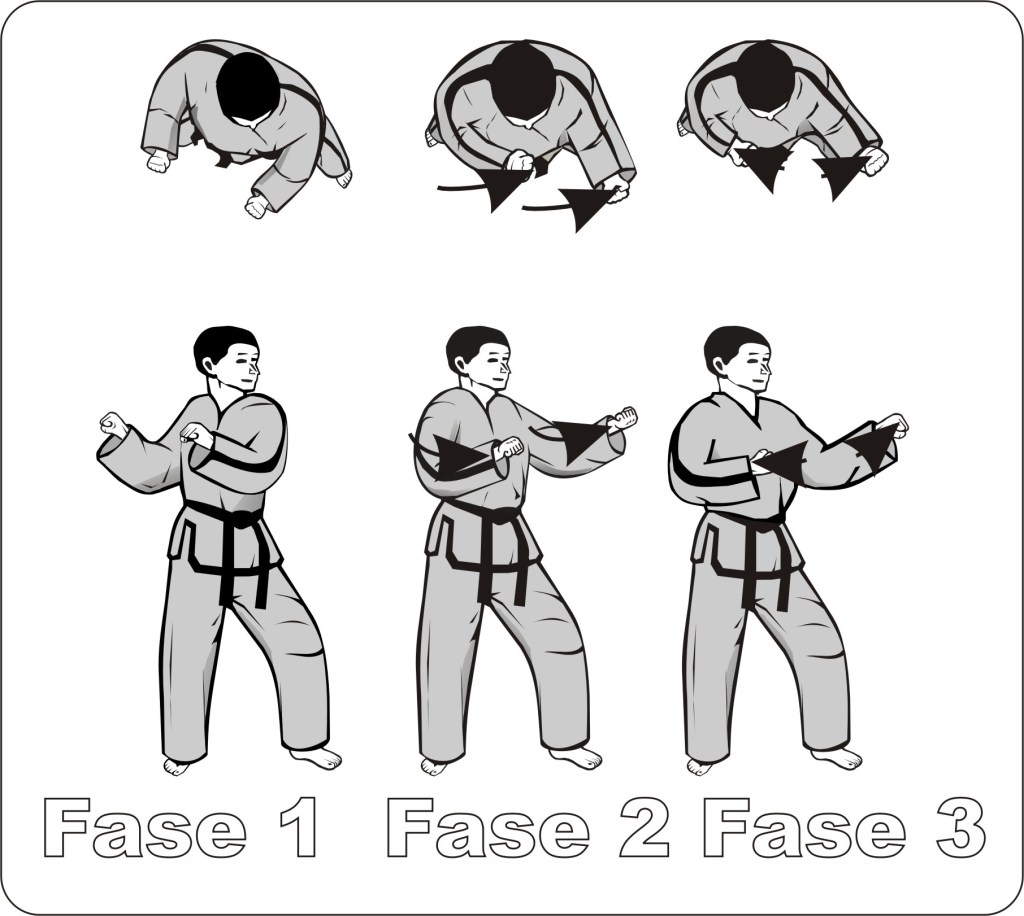
- The arms begin with fists in a parallel starting position in the middle. The hand technique has the back of the hand facing down, while the other hand (the counter-movement) is oriented with the back of the hand facing up.
- Both arms rotate (with shoulder, core, and hip engagement) simultaneously forward. The front hand moves towards the contact point, while the back hand briefly stops just before the body at shoulder height. The hands open when using a knife-hand technique.
- The front hand turns until the back side points upward and continues until the contact point, the back hand pulls back to the middle of the sternum and turns until the back side points downward.
It is a fluid movement.
Both arms first rotate forward. In the final phase, the technique continues, but the counter-movement goes the other way. This is what makes this technique special. All strength and speed are initially used to execute the technique, but at the end, the counter-movement neutralizes this. This produces an overwhelming speed and power that suddenly halts.
However, this technique is performed in this way by very few Taekwondo practitioners. I want to challenge everyone to try it so you can feel what it’s like.
Jaap
VII Taekwon-do



