
– Ready Postures –
Ready postures are postures with which the Tuls begin and end. After the greeting procedure, the Taekwondo-ka assumes one of the ready postures Chumby. The ready posture thus marks the beginning and end of the pattern in a traditional manner.
There are 10 Postures:
Chumby, Chumby A, Chumby B, Chumby C, Chumby D, Chumby E, Chumby F, Chumby G, Chumby H and Chumby I.



Traditional Taekwon-do has many different ready postures, all indicated with the word Chumby. This is used in alphabetical ascending addition from A to I. The word Chumby comes from Korean and means ‘ready´.
After the greeting procedure, a Neutral Posture is first adopted by the arms, followed by the intended Chumby stance.


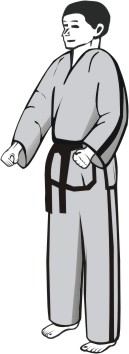
Chumby
The hands are clenched into relaxed fists and are at band height, with the outside of the wrists hip-width apart, in front of the body. The arms are slightly bent. This ready stance is made in the parallel stance.
This posture is characteristic of the original Asian warrior class, such as the Hwa Rangdo warriors, from Korea’s history. This shows both one’s strength, and the fact that one is unarmed.


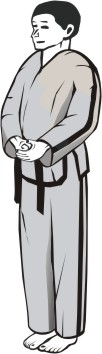
Chumby-A
Executed in the closed stance.
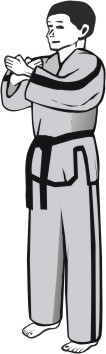
A ready position derived from the Shaolin temple martial arts techniques, which developed around 600 BC. The position of the hands symbolizes the unity between strength (fist) and wisdom (open hand).
The right hand forms a fist. The left hand wraps around the right fist. The left thumb is positioned under the right thumb, and the left fingers are curled over the right fingers and knuckles. The hands are at chin height in front of the body, and the elbows form a 90-degree angle.



Chumby-B
Performd in the closed stance.
This ready posture corresponds to Chumby-A and also symbolizes ‘strength and wisdom’.
The right hand is relaxed into a fist and is embraced by the left hand. The hands are at band-height in front of the body with the elbows slightly bent.



In a closed stance and in Tong-Il Tul in parallel stance.
A posture originating from Zen disciplines, which served to support spiritual training. The open hands combined symbolize spiritual peace.
The hands are shaped into knife hands. The left hand rests on the right knife hand. The thumb of the left hand goes underneath the thumb of the right hand. Both hands are held in line with the arms and are positioned at band height in front of the body. The arms are slightly bent.
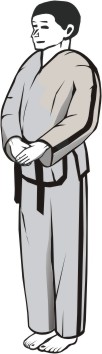


Chymby-D
This ready posture is performed in a parallel stance and only in Kwan-Gae Tul and Po-Eun Tul.
This posture is derived from Zen meditation. The elevated hands symbolize unity with the universe.
The hands form arching shapes and touch each other with the thumbs, index, and middle fingers. The center of the circle created by the hands is at eye level with the palms facing forward, or slightly upward. The arms are gently bent.
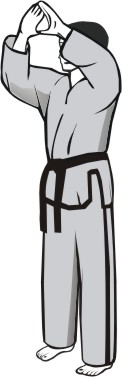



Chumby-E
In a closed stance. This posture is only used in Eui-Am Tul.
This starting stance symbolizes the ‘Taekyon’ styles originating from North Korea, where the emphasis is on the use of foot techniques and jumps.
The arms are standing beside the body and are slightly bent. The fists are slightly clenched and are positioned at the low line.



Chumby-F
In a parallel stance.
The Chumby-F posture refers to the ‘Kwon’ styles originating from northern Korea, emphasizing hand techniques.
The hands are relaxed into fists with the back of the hands facing forward. Each hand supports itself on one side, above the belt, against the side of the body. The elbows are bent and directed sideways.
This ready posture also appears in a closed stance halfway through the Toi-Gye Tul.
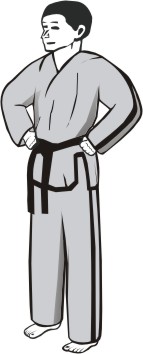


Chumby-G
Occurs only in Yoo-Sin Tul, in a parallel stance.
A stance derived from the fighting posture of the Japanese Samurai. This stance symbolizes the mental attitude before the onset of battle.
The right fist is held with the back facing down, against the side of the body at the height of the belt. The left hand, shaped like a ‘vertical knife hand’, is pressed with the palm against the front of the right fist. The left arm runs in front of the abdomen.



Chumby-H
Occurs only in Yon-Gae Tul, in a parallel stance.
A stance derived from the fighting posture of the Japanese Samurai. This stance symbolizes the mental state before the start of battle.
The left fist is positioned with the back facing down against the band. The right hand, held like a ‘vertical knife hand,’ is placed with the palm against the front of the left fist. The right arm runs alongside the belly.


Chumby-I
It occurs only in Yon-Gea Tul, in a parallel stance.
This posture has an Indo-Chinese origin and symbolizes the emergence of martial arts.
The hands are open, like a knife hand, and cross each other at the level of the middle of the chest on the vertical midline. The hands are facing the chest with the palms. The elbows are bent. The right hand is closest to the chest. The left hand is in front. The inside of the left wrist is against the back of the right wrist.


 tulsonline.com