
– Controlling Postures –
This group of four postures all share the commonality of waiting before executing the next technique. During that ‘waiting’, the body is shielded.
The controlling postures are also executed with control, meaning that the speed is slowed down and there is no explosive force involved.
There are four Controlling Postures:
Side bending-posture, Back bending-posture, Neutral-posture and Checking-posture.



Side bending-posture
In the side bending posture, standing on one leg, a defensive stance is adopted. This position also demonstrates the confidence of the Taekwon-do practitioner.
The side bending-posture is a combination of a side bending stance and the forearm guarding-block. This posture is created by simultaneously lifting one leg while the arms move forward. This maintains balance.
A left side bend posture has the left leg on the ground.



Back bending-posture
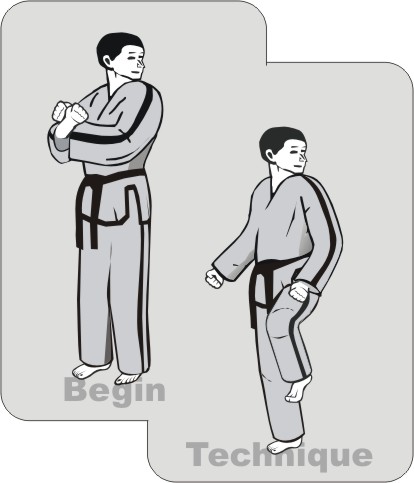
In the back bending-posture, the Taekwon-do practitioner is checking and ready to execute a backward kicking technique.
This posture is a combination of a one-legged stance and a checking posture low.
This position is achieved by simultaneously pulling the leg up and moving the arms from the starting position to the endpoint of the technique. These two opposing forces maintain balance.
A right back bending posture has the right foot on the ground.


Neutral-posture
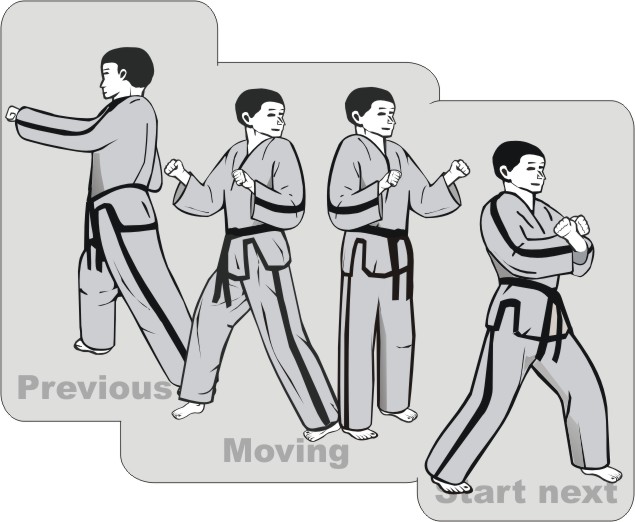
A neutral-posture is assumed between two arm techniques if there is sufficient time for it, or in this position, the arms retract when a freeing technique has been executed.
This posture gives the arms a stance that follows the natural tone of the arm and chest muscles. This posture defends the upper body.
In the neutral-posture, the hands are relaxed into fists. The fists are held in front of the body, at the level of the sternum. The outsides of the fists are shoulder-width apart. The fists are angled, with the outersides facing outward, and both elbows are bent at 90 degrees.
In principle, a neutral-posture can be adopted in any position of the Tuls after each independent arm technique. However, positions usually follow one another quickly, and then one technique transitions directly into the next without the neutral posture in between. If there is ‘much’ time between two techniques, for example, if the transition takes time, then adopting a neutral stance makes sense.

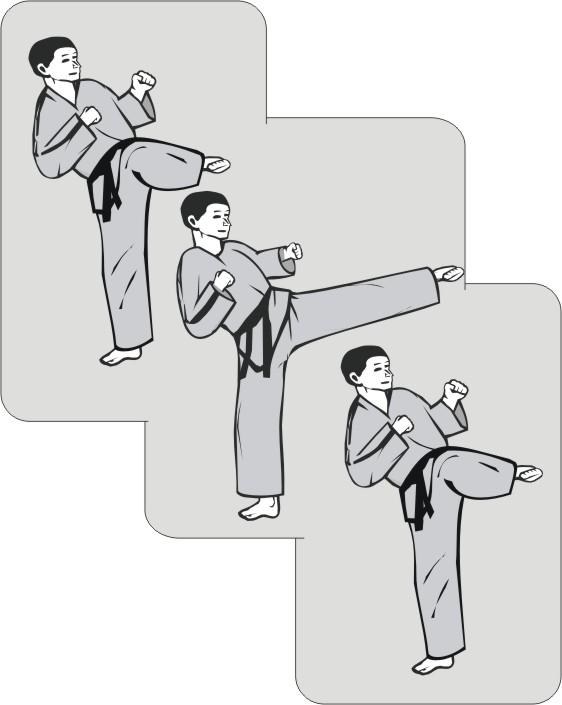
The neutral stance is applied in all foot techniques of Taekwon-do, such as the side-kick:


Checking-posture
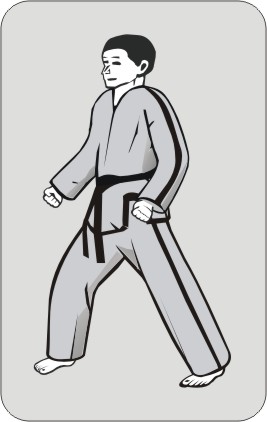
In a position where the body is protected by the arms while preparing for the next jump.
A checking-posture low shields the side of the upper body against a potential attack. In addition, this posture serves the function of ‘grounding’, meaning standing firmly on the ground to generate energy for a jump, for example.
Both fists are facing sideways. The arms are slightly bent, and the fists are held at the level of the low line. The outside of the fists is 1.5 times shoulder-width apart.
In the Tuls, this posture is used as preparation for a jumping kick.


 tulsonline.com