
– History off the Tuls –
The training forms of Traditional Taekwondo have a history that dates back to Shaolin Monasteries. This chapter describes this history.


Shaolin boxing is considered the origin of all martial arts. In a Chinese Shaolin temple, around 2000 BC, an Indian monk Daruma Taichi taught Buddhist teachings and added martial arts exercises. Probably because the monks roaming the country were exposed to physical violence quite often. This is seen as the basis of the martial arts and thus it is also the basis of the exercise forms.
In the years that followed, fighting techniques were further developed in Shaolin temples under the name Shaolin Kung Fu, which also used a fixed sequence of techniques and exercises: the first practice forms. In these exercise forms, animals symbolise the tiger, leopard, snake, crane and dragon.
From Shaolin Kung Fu, other fighting styles emerged. These styles, each with its own techniques and forms of practice, spread through Japan (especially through Shotokan Karate) and other Asian countries, to the rest of the world.
In compiling the style of Traditional Taekwon-do, it is said that Korean Taekyon and Japanese Shotokan Karate were used. Taekyon is a traditional folk sport in which people used feet to try to knock each other off balance. It is a gentle circular form of movement, which, however, did not possess exercise forms. Shotokan Karate and its exercise forms, called the katas, evolved from Shaolin Kung Fu. These katas, there are now 26 in total, have been developed over time.

Hyungs
There are many similarities between the first Hyungs/Tuls and the Shotokan katas. For example, the Pinan Kata’s contain techniques and sequences that can also be found in the Hyungs in a similar way. Tuls developed later show much less affinity

The first five
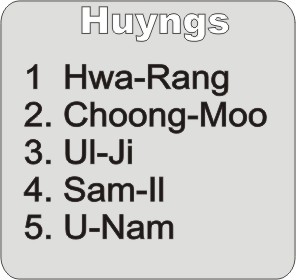
Initially (around 1959), there were five practice patterns. They were called Hyungs.

The next seventeen
Hyung U-Nam were replaced (this Hyung bears the name of the then president of Korea who was, however, deposed on charges of corruption). Taekwon-do was then given 17 Hyungs.


The last 24 Tuls
Around 1960, this changed. The name Hyung changed to Tul (plural is ‘Tuls’) and the ranking was changed. By the way, both words mean ‘practice form’ in Korean. Seven new forms were added. Compare the list from the previous page with the one on the right. The total came to 24 Tuls.
Around 1970, the Korean Taekwon-do organization split, ultimately resulting in two styles organized under two world federations: the World Taekwondo Federation (WTF) and the International Taekwondo Federation (ITF). The ITF adhered to the existing style, also known as Chang-Hon style, using the Tuls as forms of practice. The WTF developed a new style of Taekwon-do and introduced new forms, namely the Taegeuk, Poomsae, and Palgwe. These are not related to the Tuls, as far as I can determine. Choi Hong Hi left Korea and emigrated to Canada, continuing to practice Taekwon-do based on the Tuls. Much later, he returned, but this time to North Korea.
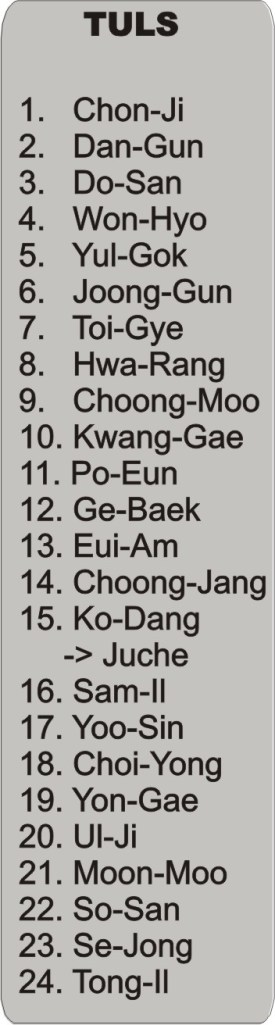
Tuls bear the name of an important person or memorable event in Korea’s history. On the right, the number of positions the Tul has often refers to circumstances of that person or event. It should be noted, however, that the number of positions is sometimes adapted to the symbolic number by combining several techniques in one position.

Ko-Dang Tul
Years after the expansion from 17 to 24 practice forms, one practice form was abolished namely Ko-Dang Tul, and replaced by Juche Tul, for questionable reasons.

Development
The Tuls (or rather the Hyungs) were not all developed by the same person. In the early days of Taekwon-do, Choi Hong-Hi’s ‘right-hand man’ Nam Tae-Hi and Bok Man-Kim (one of the 12 Taekwondo-ka who formed the first demonstration team) probably had a lot of influence on the development of the style and the first forms:
– Nam Tae-Hi contributed to the development of the first Hyungs and developed three Hyungs, namely Hwa-Rang, Chung Moo, and Ul-Ji.
– Bok Man-Kim contributed to the development of the first Hyungs.
Some others are known to have made a form on their own:
– Choi Chang-Keun co-developed Ge-Baek.
– The ‘new’ exercise forms were developed by Park Jung-Tae.
It seems that most Hyungs are collectively designed, but among the Tuls, there are some that were designed by a single person. That perhaps explains why there are forms with a distinct character of their own.


 tulsonline.com