
– L-shapes stances –
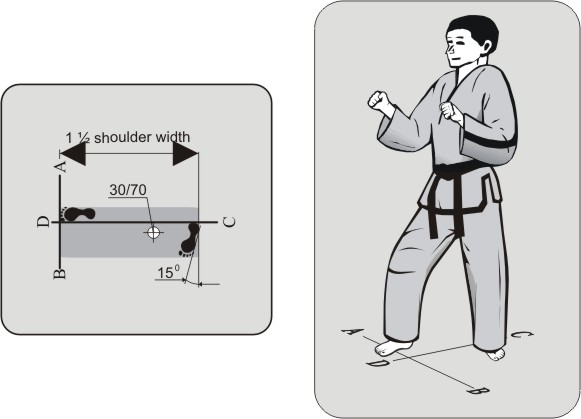
In the L-shaped stance, the front foot is facing straight ahead and the back foot is across the CD-line. The distance between both feet varies among the different stances.
The L-shaped stances are suitable for quick movement, and it is easy to perform arm and leg techniques in it. This makes it an excellent Taekwon-do stance. There are five L-shaped stances:
– L-stance, Fixed stance, Vertical stance, Rear foot stance and Kneeling stance.



L-stance
An L-stance has the front foot facing forward. The back foot here is with the foot 15 degrees from the AB line inwards. The legs are both slightly bent. The front knee is above the ankle, the back knee above the ball of the foot. The upper body is rotated about 45 degrees from the CD line.
The stance has a relatively high body center of gravity and a small support surface. In an L-stance, the Taekwondo-ka can therefore maneuver quickly forwards, sideways, backwards, sliding and jumping. Kicks can also be made easily with both the front and back leg.
A left L-stance has the left leg behind.
Weight distribution: front leg 30% and rear leg 70%.
Dimensions long: 1½ shoulder wide and wide: 1 foot long + foot wide.


Fixed stance
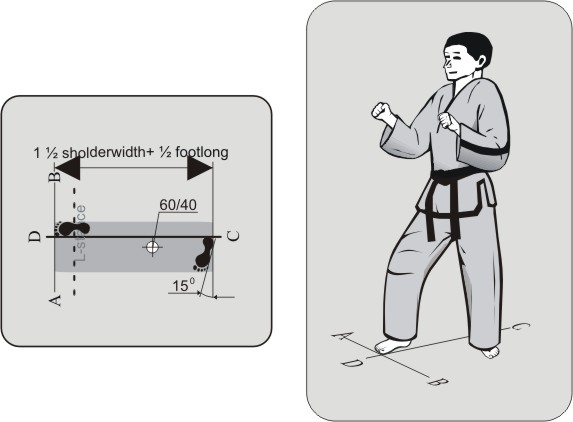
This stance is half a foot longer than the L-stance. The front foot points straight ahead, and the back foot is positioned directly behind it on 15 degrees from the AD line. Both legs are bent, with the back leg more so than the front leg. The knees are directly above the feet. The upper body is approximately at a 40degree angle from the AB line.
The support surface is slightly longer and the body’s center of gravity is slightly lower than in the L-position, which provides greater stability.
The fixed stance gives the Taekwon-do practitioner the ability to bend the upper body slightly more forward (towards D) than in the L-stance.
A left fixed stance has the left leg behind.
Weight distribution: front leg 40% and hind leg 60%.
Dimensions: length 1½ shoulder width + ½ foot length & width foot length + foot width.


Vertical stance
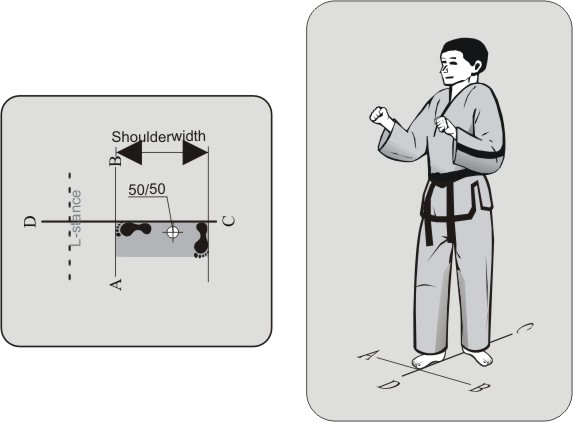
The vertical stance is the shortest of the L-stands. The feet are almost next to each other. The back foot is perpendicular to the centerline, while the front foot points in the direction of the centerline. The support area is one shoulder width long. The legs are nearly straight. This gives the stance a high center of gravity with little stability. The upper body is approximately 70 degrees off the AB-line.
The vertical stance makes the Taekwon-do tall, allowing downward arm techniques to come into their own effectively.
A left vertical stand has the left leg behind.
Weight distribution: both legs 50%.
Dimensions: long shoulder width & wide foot length.


Rear foot stance
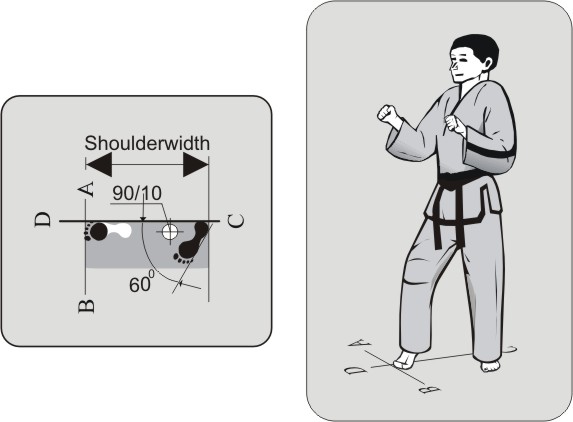
The front foot is positioned with the ball of the foot on the ground, pointing straight forward. The back foot is placed sideways and is at an angle of 60 degrees to the CD line. The weight is mainly resting on the back leg. Both legs are slightly bent. The upper body is approximately 60 degrees tilted relative to the AB line.
The rear foot stance has a long and narrow support base that creates a ‘retreated’ posture, partly due to almost all the weight being on the hind leg. The center of gravity is high. This allows for quick arm and leg techniques, especially with the front arm/leg.
The left rear foot stance has the left leg behind.
Weight distribution: hind leg 90% & front leg 10%.
Dimensions: long shoulder width & wide foot length.


Kneeling stance
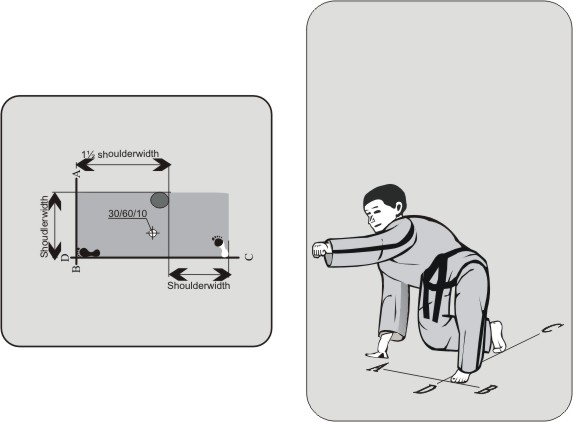
The front leg is resting on the whole foot, while the back leg is positioned with the knee and the ball of the foot on the ground. The foot of the front leg is facing forward, and the knee is bent at a 90-degree angle. The other leg is lying with the shin and the ball of the foot on the ground. The shin is rotated 45 degrees away from the CD line. The distance between the outside of the knee and the outside of the front foot is shoulder-width apart. The ball of the back foot is in line with the outside of the front foot. This position can be compared to an L-stance. The upper body is turned about 30 degrees in relation to the CD line.
Getting up from this position can be done quickly. From the kneeling stance, all hand techniques can, in principle, be executed. A foot technique with the front leg is also possible, but in that case, the position relies on both hands.
A left kneeling stance has the left leg in front. This stance only occurs in Choong-Jang Tul.
Weight distribution: front leg 30% & hind knee 60% & hind foot 10%.
Dimensions: length 2½ shoulder width & width shoulder width.



 tulsonline.com