
– This is why the Sinewave does not work –


The style of a large part of the organizations that have emerged from traditional Taekwon-do uses the so-called Sinewave to create techniques.
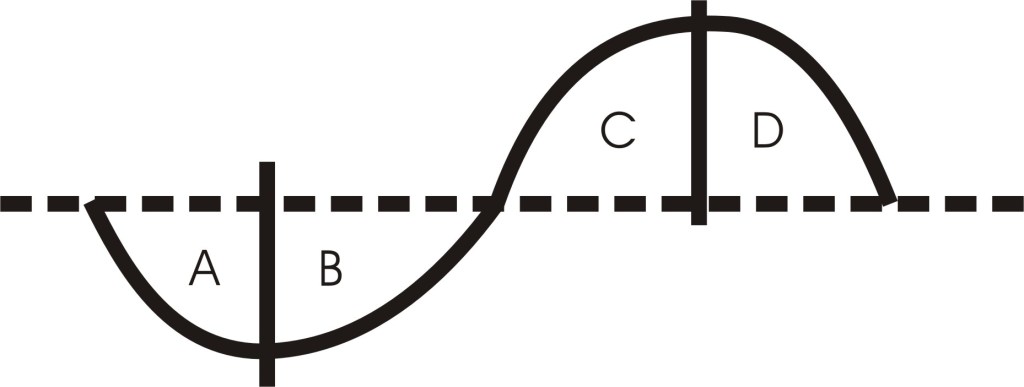
In this approach, for every arm technique the Taekwondo practitioner first moves their body downwards, then upwards, and finally back down slightly so that it returns to the original level. This movement has a sinusoidal shape. The shoulders and hips hardly move. The movement originates from the legs, causing the whole body to go up and down.

1. Unnecessary movements
The idea behind this is that the bodymass of the downward movement adds force to the technique.The body goes down (A), up (B+C), and back down again (D). The energy that can theoretically be converted is the downward ‘falling motion’ of the body from the highest point to the level of the contact surface. This ‘falling motion’ is interrupted and halted, releasing energy. All the movement prior to this in the SW, going down first and then up, does not contribute to this. Therefore, it is unnecessary. In principle, you can suffice with just going up and then going down.
2. The body has a downward force.
The biggest limitation of this power play is that the downward force of the body does not have the same direction as the technique.

(The length of the arrow represents the strength of the force, F1 is technique power, F2 is power from de body goes downward and F3 is the resul of these two)
In a forward technique, the forward force of the technique (F1) and the downward force of the body (F2) result in (F3), which is slightly greater than F1. In an upward technique, F3 is less than F1, and in a downward technique, it is greater than F1.
However, even if only moving upwards and downwards, the addition remains slight. With an upward technique, the force is even diminished. A downward technique benefits more from it. Additionally, for arm techniques such as a strike or block that travel alongside the body, the contribution is negligible.
3. There is no stable connection between the body and the arm.
Converting a downward movement into a forward force requires a stable connection between the body and the arm. That is not the case, so only a fraction of the force is converted.
To try this out: extend one arm and let the fist come down onto an object, merely by lowering the body. This is the downward force of the body in the SW.
Conclusion
The power generated by this sine wave is minimal and sometimes negativ. It depends on the direction of the technique. The time required for the sine wave is considerable and is not proportional to the yield.
There are better methods. This approach contradicts the techniques described on this site and is executed with counter-movement, rotating shoulders and hips, and extension from the back leg. This is the technique of the Hip Engagement.
Take the test and perform a break test with it. Then you’ll see that the Taekwondo-ka rotates from the hip.
The SW was not introduced to improve Taekwon-do but to increase the distinction between ITF Taekwon-do and WTF Taekwon-do. The essence of empowering is made subordinate to this.
My advice is therefore:let the sine wave exist in its natural movement, allow the counter-movement and the shoulders to rotate along with the technique, and introduce hip engagement here.
The following blog is about whether it is significant that there are different styles within a style of Taekwondo. See https://tulsonline.com/blog-2/



