
– Parallel stances –
The stance is characterized by both feet standing wide apart, parallel to each other and facing forward.
The parallel stances are very suitable for stepping sideways during front attacks, defending and making counterattacks with hand techniques. There are three variants:
Parallel stance, Sitting stance and Diagonal sitting stance.



Parallel stance
The parallel stance has both feet facing forward, parallel to each other at (outer foot) shoulder-width distance apart. Both legs are almost extended. The stance has a small support area and high centre of gravity. This makes the stance not very stable. There is one Parallel stance.
Arm techniques can be performed in all directions, preferably in the middle and high range.
There is no right or left parallel stance.
Weight distribution: both legs 50%
Dimensions: foot long and shoulder wide wide.



Sitting stance
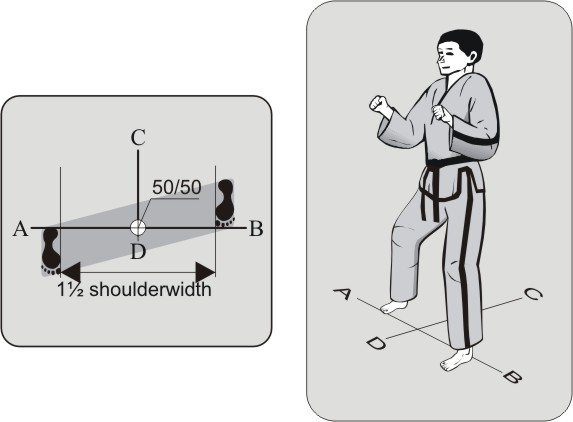
In the seated position, both feet are parallel to each other and facing forward, 1.5 shoulder-width apart. The toes of both feet are pointing towards the AB line. The legs are bent with the knees directly above the ankles. The upper body is parallel to the AB line.
Due to the wide support base and the low center of gravity, the seated position is stable sideways. However, the stability is significantly less when leaning forward or backward. Since the feet are parallel, ‘grounding’ is also quite feasible.
There is no right or left seating position.
Weight distribution: both legs 50%.
Dimensions: long foot length & width 1½ shoulder width.



Diagonal sitting stance
In the diagonal sitting position, the feet are also parallel to each other; however, the front of the toes is not aligned with line AB, as one foot is placed slightly behind the other. The feet remain the same width apart as in the sitting position. The upper body is parallel to the AB line.
The strength of the standing position, whether forward or backward, has been increased compared to the sitting position. This allows for more force to be exerted or more mass to be absorbed in a forward/backward direction. The diagonal sitting position is used occasionally in the Tuls.
A left diagonal seating position has the left foot in front. In the Tuls.
Weight distribution: both legs 50%.
Dimensions: length 2 feet & width 1½ shoulder widths.


 tulsonline.com