
– Technique variations –
Normally, techniques move to the impact point as quickly as possible, after which the next technique is deployed. Various variations are possible on this: Keeping the position, Releasing, Circle, Checking and Grabbing



Keeping the position
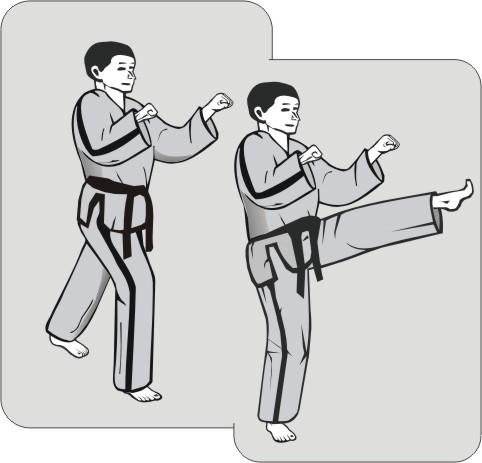
This situation is composed of two positions. A block has been executed against an attack. The block then continues to control the attacker until a counterattack is made. In this case, the attacker essentially leans against the block.
The second technique would not be possible if the arms from the first technique returned to a neutral position, as the attacker pushes forward to reduce the distance. The arms prevent this by remaining firmly in place, allowing the technique to still be executed.


Releasing
This is used when the Taekwon-do practitioner is grabbed by the hand, wrist, forearm, or upper body. However, the attack is never clear. The emphasis is on the technique of releasing.
In releasing hand techniques, the moment of rotation occurs at the beginning of the technique rather than at the end, as is customary. The arm is also forcefully retracted to a neutral position, undoing the grip.
In the Tuls, several different releasing techniques are incorporated, which must be performed in the aforementioned manner.
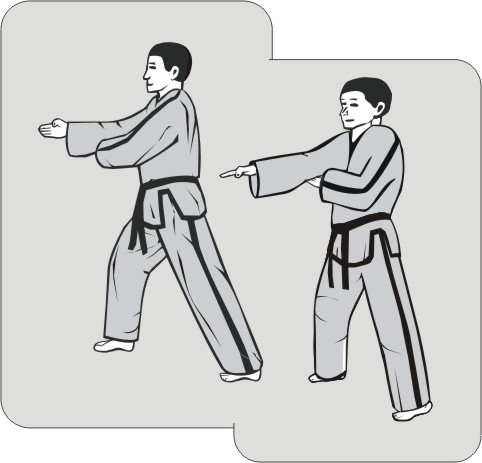

In more than ten movements in the Tuls, it is stated: ‘Draw the hands back in a releasing motion to a neutral posture’. Originally, this was described as; ‘Pull the hands in the opposite direction’. This movement has been interpreted logically, namely that the hands are withdrawn from a grip.



Circle
If the arm technique needs to be circular, it requires a different approach to the impact point than normal.
Then the hands go from the beginning in as large an arc as possible to the point of impact. This increases the speed of the technique at the point of impact and allows for more body mass to be used. This technique delivers a massive block.
This technique is used only in the inner knifehand-guarding-block low.



Checking
Checking to stop
A controlling technique stops an oncoming opponent, causing them to come to a halt and lose their balance. These can be both arm and leg techniques.
This technique is executed forcefully on the ‘inhalation’ with a delayed speed. The subsequent technique goes directly on the exhalation. The opponent is stopped and is immediately attacked with a counter-offensive.



Checking to restrain
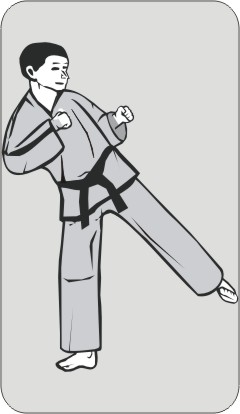
It lies in the nature of Taekwon-do to execute a technique quickly and powerfully, and then to create distance again. With control, the attacker is blocked or restrained with a subtle movement. This prevents the attacker from continuing with a subsequent attack. This gives the Taekwondo practitioner the opportunity to strike back.



Grabbing
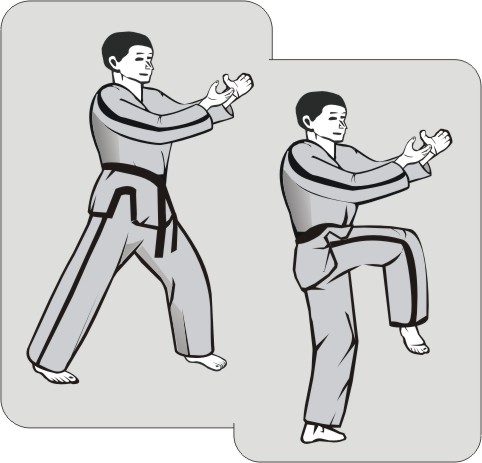
Grabbing the opponent and pulling them towards you is perhaps the last thing you would want to do as a Taekwondo-ka. It’s preferable to keep someone at a distance to utilize leg and arm techniques. However, there is a good reason to do it when an opponent has come close. By grabbing them, they can be dealt with using a knee technique, as long as they stay within reach.
A vertical-grip grabs the opponent’s head and holds it in place. The upward knee strike will then hit its target because the opponent cannot lean back.



 tulsonline.com