
– Walking stances –
The walking stances are stable stances. They have a low centre of gravity and a large support surface. Walking stances are very suitable for powerful arm techniques, also because the hip engagement is well supported by the stretching of the back leg. These stances are therefore widely used in the Tuls. There are two options:
Walking stance and Extended walking stance.



Walking stance
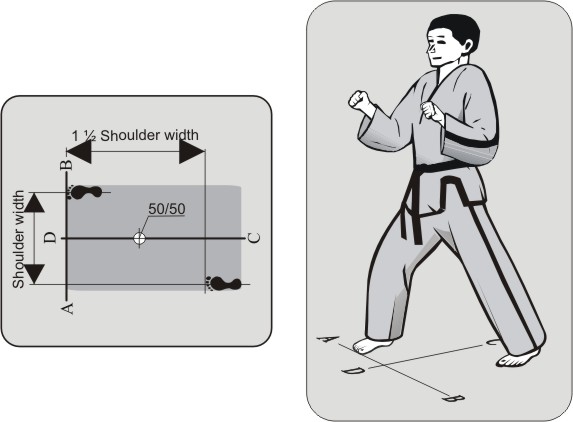
In this stance, both feet stand straight forward, parallel to the CD line. One leg is in front and one behind. The back leg is extended. The front leg is bent and stands with the knee straight above the ankle. The upper body is parallel to the AB line.
The walking stance is a stable and forward-facing stance with a low centre of gravity and a large support surface. This makes the stance less suitable for performing quick leg techniques. Direct turning is possible in this stance to the open side of the stance, for example to a sitting stance.
A right walking stance has the right leg in front.
Weight distribution: both legs 50%.
Dimensions: long: 1½ shoulder wide and wide: shoulder-width.


Extended walking stance
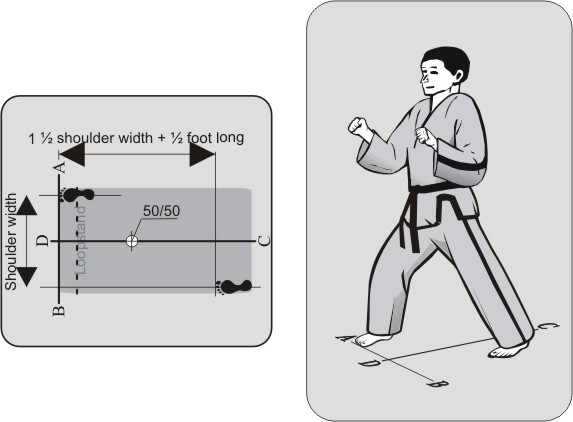
The extended standing position is derived from the walking stance. The extended position is half a foot length longer. Both feets points in the front direction and stand equally wide.
This stance gives the technique an arm technique a large reach.
A right extended stance has the right leg in front.
Weight distribution: both legs 50%.
Dimensions: length 1½ shoulder width + ½ foot length and one shoulder width.



 tulsonline.com