


A block, indicated by a strikethrough of the word, is a technique used by the defender to stop the opponent. If he does not do this, the opponent will hit him. In the Tuls, there are several blocks that meet this requirement.
However, in most common blocks in Tuls, a block is not used to stop the attacker, but rather as an attack on their technique arm or leg to unbalance them. The first response on a technique namely, is to move away so that the attack does not hit. Usually, this involves stepping back, but moving sideways or even turning towards the attacker is also possible. In principle, even without a blocking, the attack would not hit its target and thus would be harmless. After moving, the Taekwondo-ka executes a technique against the attacker; the blocking. This technique is often aimed at the arm or leg with which the attack was executed. The purpose of this technique is to get the attacker out of balance. Timing, speed, direction, and precision of this technique are of great importance. Power, on the other hand, is generally less important.
One third way to perform a block is as a ‘warning’ to the opponent. The technique does not actually block, but the posture is a clear signal to the opponent(s) of the strength and resoluteness of the Taekwondo-ka.
The story of the blocks is not yet complete. An important aspect of blocking lies in the starting positions of the arm techniques and the controlling movements that sometimes complement these arm techniques. These blocks defend the Taekwondo practitioner by putting down a barrier. It is, in a sense, a passive defense.
In partner exercises, attack and defend is the core of the exercise. In the Tuls, this is much less the case. Stepping away from the point of impact of the attack, is not applied in many Tuls (see Blog 3, What the Tuls learn us). Because there is no real attack, timing and precision are also less visible. Nevertheless, the Tuls lay the foundation of the technique, as the blockings occur frequently and thus an automatic response develops during execution.
Blockings in the Tuls are only performed using hand techniques. But leg-blockings are also possible. In partner exercises, they occur regularly. The principle of these blockings is the same as that of the hand techniques.

The blocks that stop the attacker.
Block the attacker
In the Tuls, there are several defensive techniques designed to stop an attacker in their forward movement. These techniques are applied before the attacker can execute their technique. For example: a pressing punch. This technique is executed with body mass behind it and punches the attacker so they cannot get closer. Here, speed is not important; timing and placement are. Often, the technique is quickly followed by an attack or is a combination with an attack.
Examples of this are: right pressing fist-punch middle (Yul Gok Tul, mov. 1), left pressing fist-punch low and an right inner forearm-block middle (Hwa Rang Tul, mov. 26)
Blocking the Technique
By using a technique to intercept the attacking technique, the Taekwondo-ka prevents being hit. The block, such as a forward forearm-block, absorbs all the force applied to it. An attack could be a spinning hooking-kick. The block is already ready just before the technique would land. Only attacks that come towards the Taekwondo-ka in an arc can be defended against with this.
Examples include: Parallel foreward outer forearm-block (Yuche Tul, mov. 4) and a Twin archand-block (Ge-Baek Tul, mov. 7).

Blocks that change the attacker’s direction.
Block to change direction
This is the most commonly used way to neutralize an attack. For example: a fist punch (F1) is redirected by a forearm block (F2).
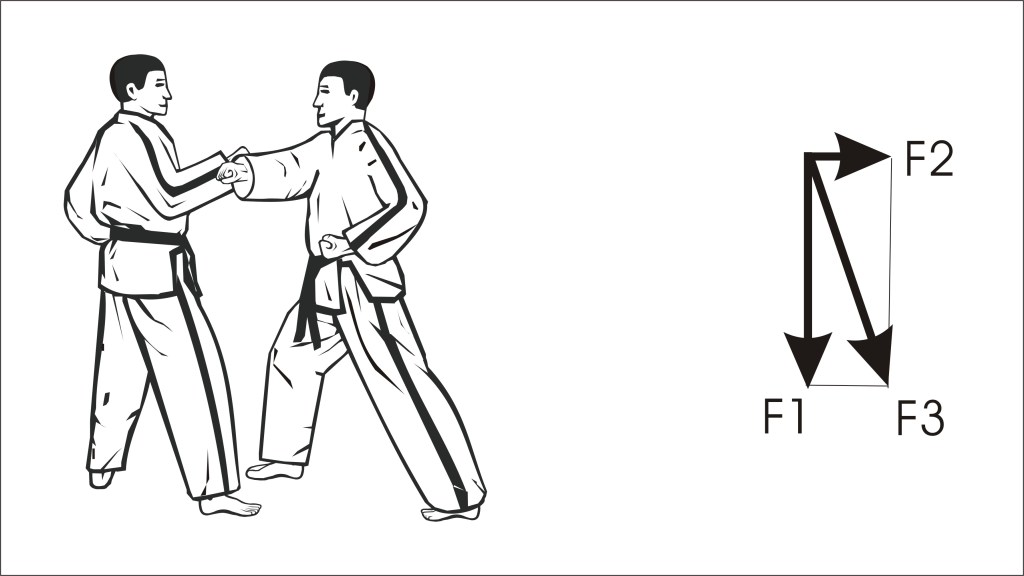
The result of this is F3, which has a value greater than the force of the attack (F32=F12+ F22).
The force generated (F3) causes the attacker to become (temporarily) unbalanced, making a quick follow-up attack not immediately possible. During that time, the Taekwondo-ka makes a counter attack . F2 can be executed horizontally across F1, but also vertically. In all cases, it generates a greater F3 force. It is important that the blocking makes contact at the moment when there is still force in the attack (timing), and that on the the right place and in the right direction is reached. This uses the force of the attack to throw him off balance.
Basically all forearm- and knifehand-blocks.

Block and grab
The attack is defended with a checking block. A fist thrust (F1) is grabed with a hooking palm block (F2). This creates a moment of fixation and a pulling force in the same direction as the thrust. F3 in the direction of the attacker’s thrust is the result, causing him to lose his balance.
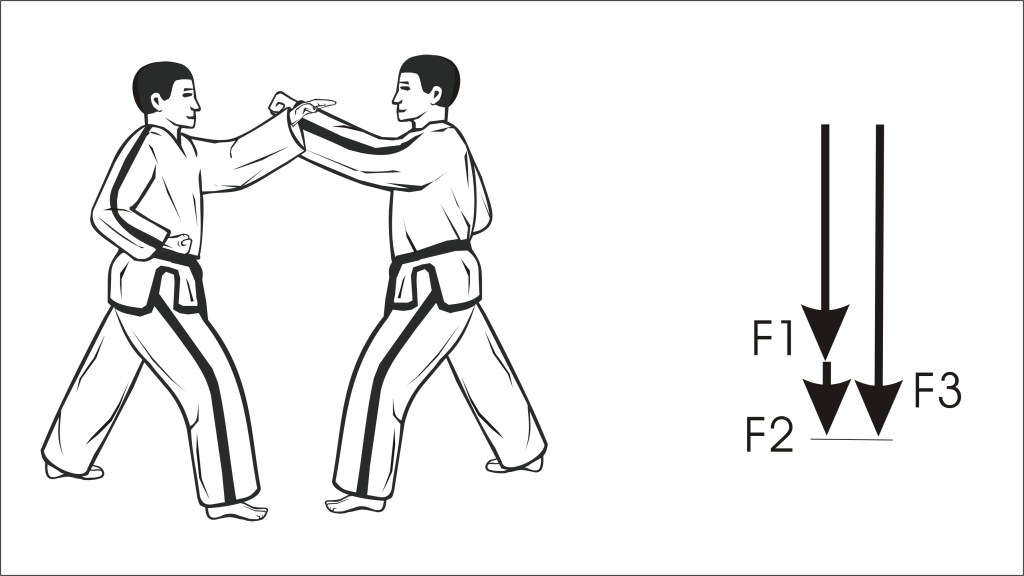
In this case, F3 = F1 + F1.
The hooking block is not very powerful, but it doesn’t have to be since this force is added directly to that of the attacker. There are various blocks that make use of this principle.
For example: Hooking palm-block (Yul Gok Tul, mov. 15), Archand-block upward (Moon Moo Tul, mov. 60)

Block and hold
A number of blocks are suitable for, after blocking, also hold the attacker,to make the counterattack extra effective. For example, take an upward X-shape checking knifehand-block. The attack, such as a forward kick, is lifted and held for a moment. The attacker is off balance.
For example: X-shape checking knifehand-block (Ge-Baek Tul, mov. 1).

Blocks causing pain
This is one of the possibilities of a block if an attack cannot be stopped with a ‘normal’ block. This block will be delevert at a vital point so that the attacker withdraws their arm or leg due to the pain it causes. For example, a turning-kick is defended with a knifehand-block. That block cannot withstand the force of the kick and would therefore not intercept the attack. However, the sharp edge of the outside of the knife hand on the shin of the attackers leg will cause immediate pain. It is not the counterforce, but the causing of a pain reaction that nullifies the attack.
Fore example: all knifehand-blocks.

Block and throw away
One of the special ways to use a block is when the leg or arm of the attacker is thrown away with great force. A technique that does this is, for example, the circular inner forearm block. The low attack is picked up and brought up and out in a circle. This not only puts the attacker off balance but also takes them away from the Taekwondo-ka.
See the: circular inner forearm-block middle (Won-Hyo, mov 19).

Blocks as a warning
Guarding blocks
One of the most impressive stances in all Taekwondo techniques are the guarding blocks, such as the guarding knifehand-block. This is introduced in Dan-Gun Tul. With this block, one can defend using the front knife hand. However, the stance and technique primarily demonstrate the strength and tenacity of the Taekwon-do spirit. This can intimidate an attacker, making it a defensive action.
A guarding forearm-block is used in a side bending stance. Standing on one leg creates an even greater impact and holds significant symbolic value.
See for example: guarding knifehand-block (Dan-Gun Tul, mov. 1) and a side bending-posture (Won-Hyo Tul, mov. 7).

Passive defences
Neutral posture
The arms of the Taekwondo-ka are in a neutral posture in the Tuls when the transition between one technique and another is significant. For example, during a movement that takes time, where the arms have ‘nothing to do’ for a moment. The fists are relaxed in front of the chest, and the forearms and elbows protect the body.
See: Do-San Tul mov. 3.

Starting postures armtechniques
There are three basic positions from which hand techniques begin: an extended, parallel, and crossed starting posture. All arm techniques start in their own way from one of these postures. In addition to being the starting point for arm techniques, these postures also protect the body by covering as many vital points as possible with the arms.

Supporting positions armtechniques
There are techniques in Tuls that prevent the attacker from advancing against the Taekwondo-ka. For example, a finger-thrust middle. This involves a counter-movement that not only supports the finger-thrust but also places the forearm well in front of the body of the Taekwondo-ka. This forearm acts as a passive block, in case the attacker moves forward.
Also, techniques where the supporting hand has a controlling function, for instance, when a knife-hand is held on the wrist of the technique hand, are intended as such a passive blockade.
The same is the case with the guarding- and double blocks.
See fore example: a frontal vingertip-thrust middle (Do-San Tul, mov. 7A), an ‘check the technique with the fingertips of the knifehand on the palmside of the wrist’ (Po-Eun Tul, mov. 13) technique and a double inner forearm-block ( Yul-Gok Tul, mov. 37).
Foot techniques
The famous Taekwon-do kicks are supported by hip movement and a motion of the upper body. The arms are in a neutral posture (or it should be indicated in the description in the Tul that they maintain a previous position). In that neutral posture, the arms protect the upper body as a passive blocking mechanism.



