
– Starting Postures –
All hand techniques begin in a starting posture. This posture indicates where the technique and, if applicable, the counter-movement begin.
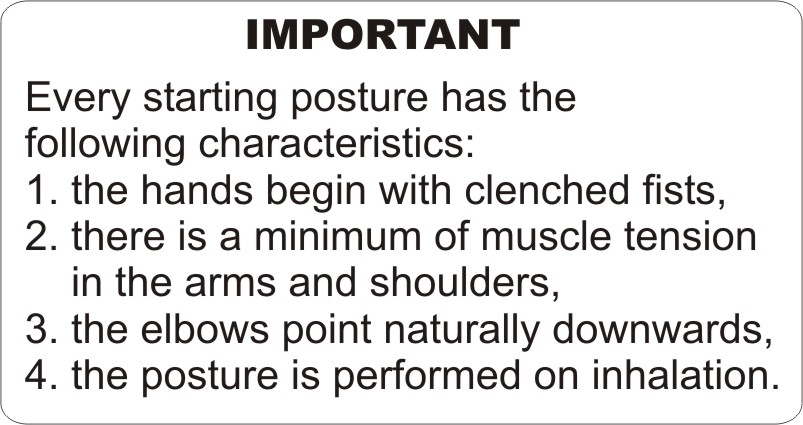
When executed this way, the starting posture offers protection, makes the techniques quick and effective, and prevents arbitrariness.
All starting postures can be divided into three main groups: crossed – extended – and parallel starting postures.



Crossed starting posture
These starting postures begin with the fist of the counter-movement and that of the technique with the wrists pressed together. There are two possibilities, from the ‘vertical midline’ and from the ‘flank line’:
Crossed starting posture from the vertical mid-line.
This posture begins with both fists placed in front of the body at chest height. In this position, both arms perform a technique. Both arms are bent so that the wrists cross each other, centered in front of the body. The fists are facing forward or directed towards the body, opposite to the position at the contact point. The elbows point downward and are slightly bent at more than 90 degrees. The point where the wrists meet is at the level of the chest.
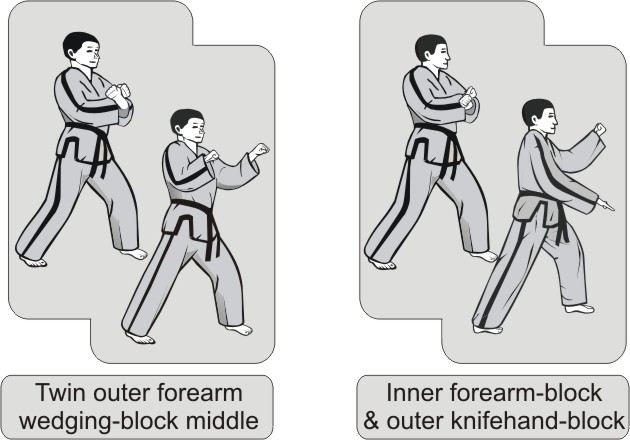


Crossed starting posture from the flank-line.
Both arms start at the left or right shoulder line. One arm executes the technique, while the other arm is used for the counter-movement. The counter-arm points forward, is slightly bent, and has always the fist raised. The technique arm crosses in front of the body and can either lie on top of it, with the back of the fist facing down, or underneath, with the back facing up.
If, in the technique being executed, the back of the technique hand points down at the contact point, then in the starting posture, the wrist rests on the counter-arm with the back facing down. And vice versa. The wrists of the arms lightly touch each other.
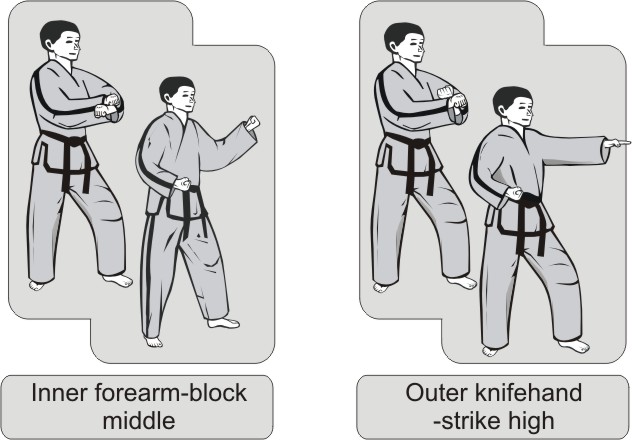



Extended starting posture
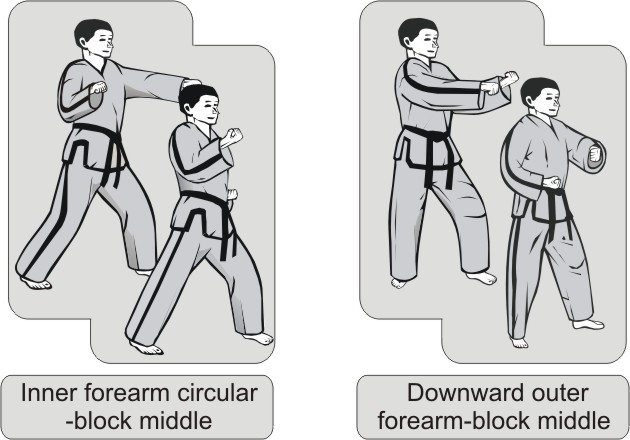
In the extended posture, the counter-arm is always held horizontally straight forward along the flank line. Here, the fist is turned with the back side facing up and goes straight backward to band height or to the middle of the chest. Just before the end, the fist turns so that the back side is facing down.
Extended starting posture from the belt
The technique moves forward from the band to the point of contact, where a turn is also made at the end. The counter-arm is stretched.
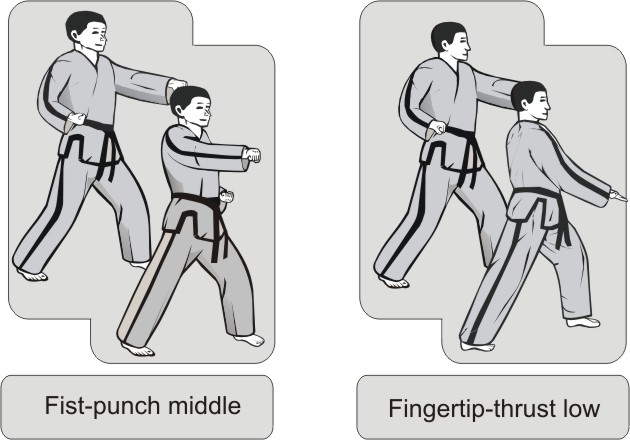


Extended starting posture from middle
The technique can also start in the middle position. Then the hand is 45 degrees outside the flank line.


Extended starting posture from high
At a high level, the technique can start at a 45-degree angle or directly in front of the flank line. Of course, the fist is turned opposite to the point of impact at the start.




Parallel starting posture
In the parallel starting posture, the forearms are parallel to each other. From this position, both arms can perform a technique, or one arm is for the technique while the other makes the counter-movement. There are three height variations for the fists: low (next to the band), middle, and high.
Parallel starting posture from the belt
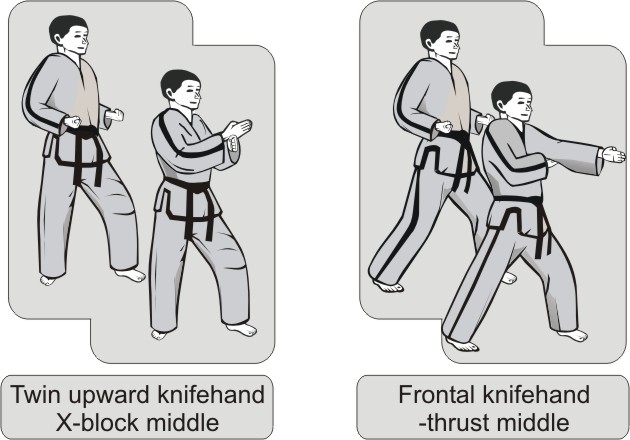
Both fists make the technique and start at band height from the body with elbows pulled back and the forearms parallel to each other. The fists are both turned downwards.


Parallel starting posture from middle
Both arms are bent in front of the body, with the fists placed on the flank line at chest height. The forearms are parallel to each other and are slightly away from the body. The elbows point downward. The hands are oriented with the back side facing down or up, depending on the technique.


Parallel starting posture from high
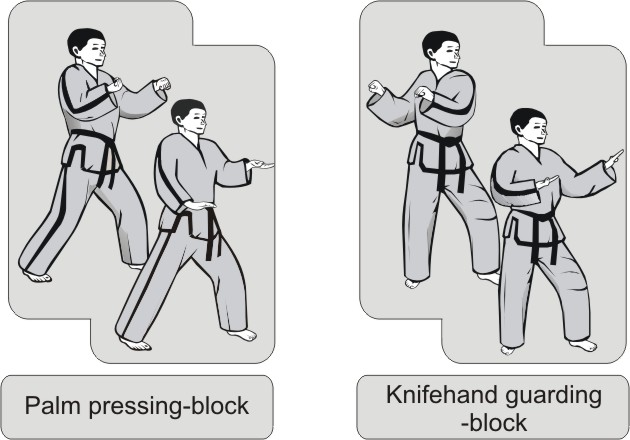
There is only one application: the W-block. Here the fists are positioned sideways from the body with the forearms vertical and the upper arms horizontal. The fists start with the outside facing backward. The arms are positioned outward next to the shoulders and do not move. Only the fists rotate inward at the pivot point, while the arms remain in the same place.



 tulsonline.com